The 21st meeting of the EU-China Round Table, jointly organized by the China Economic and Social Council (CESC) and the European Economic and Social Committee (EESC), was recently held in Hangzhou. Yi Lu, Chair Professor at the PBC School of Finance, Tsinghua University, was invited to speak on the theme of “People-centred artificial intelligence,” sharing his views on AI’s impact on the labor market and how to respond.
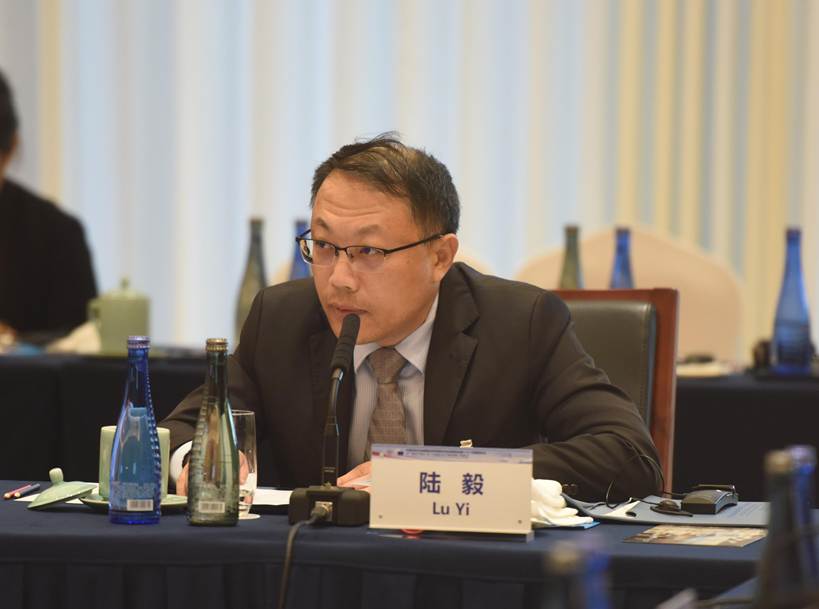
(Yi Lu speaking at the meeting)
Lu noted that the most common public concern about AI and employment is whether AI will replace human workers. From the steam engine to electricity, and from computers to the internet, he said, each wave of technological change has reshaped the division of labor. This trend cannot be avoided, nor should it be. The central question is how to respond proactively and make the necessary adjustments.
To determine how to adapt, Lu emphasized, it is first necessary to understand the macroeconomic context in which AI is affecting the labor market. This is not an isolated technological event: it is unfolding amid shifting global financial conditions and the geopolitically driven restructuring of global supply chains.Two Directions for Responding to the Impact of Artificial Intelligence
Against this backdrop, Lu identified two particularly important directions for action. The first is to develop workers’ skills in ways that complement AI and enable human-AI collaboration.
Two Directions for Responding to the Impact of Artificial Intelligence
Compared with earlier technological revolutions, Lu explained, a defining feature of this wave of AI development is its deeper reach into cognitive work. AI is taking on parts of tasks such as text generation, data analysis, coding and translation, which previously relied heavily on human intellectual effort. This raises a fundamental question: if machines can replace physical labor and algorithms can perform cognitive tasks, where does the comparative advantage of human workers lie?
Lu argued that the answer lies in areas where AI cannot independently take responsibility for the consequences of decisions. In fields such as law, healthcare, finance and education, AI can provide analysis and propose solutions, but humans must still make value judgments, weigh ethical considerations and bear ultimate responsibility. Society cannot simply delegate decisions concerning fairness, justice and human life to algorithms. Institutional arrangements and public trust require human accountability. Human-AI collaboration therefore has concrete institutional implications. Targeted vocational skills training should help promote deeper integration of innovation, industrial, capital and talent chains, enabling workers to master and use AI tools and take on roles involving judgment and decision-making in the new division of labor.
He added that vocational training tied to specific technologies is not enough. Technological change is accelerating, and the useful life of specific skills is becoming shorter: a tool mastered today may soon be updated or superseded. For the longer term, he argued, it is more valuable to invest in workers’ foundational capabilities. These include a solid grounding in science and the humanities; the ability to learn independently and quickly apply what they have learned to new problems; and the ability to communicate, collaborate, understand others and manage disagreements—qualities that are essential in any occupation.
The second direction is to improve both redistribution mechanisms and the system for safeguarding livelihoods. Lu explained that redistribution deserves particular emphasis because technological progress has a fundamental characteristic: its benefits are widely distributed, while its costs are concentrated among particular groups. The impact on displaced workers is tangible and immediate. If institutional arrangements fail to address this asymmetry effectively, public acceptance of technological change will be weakened, which in turn will constrain the growth potential that technological progress can generate. Groups heavily affected by technological displacement therefore need support through retraining for re-employment, social assistance and transfer payments to protect their basic livelihoods and their rights and opportunities for development. This requires a coordinated institutional framework in which primary distribution, redistribution and tertiary distribution complement one another. Particular emphasis should be placed on the fundamental role of taxation and social insurance in shaping income distribution, while strengthening the social protection system, improving its long-term sustainability and strengthening social protection for key groups.
Technological Innovation and Basic Livelihood Security
In his address, Lu cited important remarks by General Secretary Xi Jinping on how a new wave of scientific and technological advances and industrial transformation has spurred economic development while also profoundly affecting employment and income distribution. He quoted Xi as saying, “This includes certain negative impacts that we must take effective steps to address.”
The Outline of China’s 15th Five-Year Plan sets out measures for the full implementation of the “AI+” initiative and calls for strengthening AI’s contribution to job creation. These measures provide important guidance for assessing and responding to AI’s impact on employment.
Lu stressed that AI development should enhance human capabilities and advance human development. The fundamental purpose of economic development is to improve people’s well-being. Raising workers’ incomes and improving people’s quality of life are integral to a people-centered approach to development. The benefits of AI should be shared more fairly and more widely across society, without widening the digital divide or deepening social divisions.
Lu concluded that AI will inevitably reshape the labor market, but technology alone will not determine the direction or outcome of that change. Global financial conditions, the structure of industrial and supply chains, and each country’s institutional endowments and policy choices will together shape the process. Advancing technological innovation while ensuring that people’s basic needs are met is a governance challenge shared by all countries.
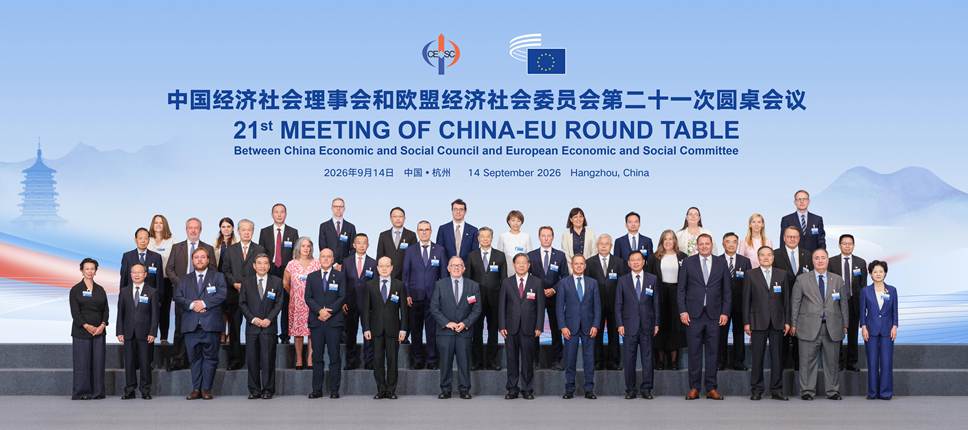
(A group photo of the meeting participants)
The EU-China Round Table is a dialogue mechanism jointly organized by the China Economic and Social Council and the European Economic and Social Committee. Its 21st meeting took place in Hangzhou on September 14, 2026, bringing together 37 representatives from China and the EU. Participants held in-depth discussions on three themes—addressing poverty and promoting social inclusion; promoting higher-quality and more efficient EU-China trade and investment; and people-centred artificial intelligence. Participants also explored new opportunities for cooperation between China and the EU.