On September 29, 2026, a seminar on ESG evaluation for China’s publicly offered real estate investment trusts (REITs) was held at Tsinghua University PBC School of Finance (PBCSF). The seminar was jointly organized by the Research Center for Investment and Financing Policy at Tsinghua University, the Research Center for Finance Development and Regulation Technology at PBCSF, and the Capital Business Innovation Consulting Center of China International Engineering Consulting Corporation (CIECC).
Attendees included Jiao Jie, Dean of PBCSF; Zhang Jianhua, Director of the Research Center for Finance Development and Regulation Technology; Yang Yongheng, Director of the Research Center for Investment and Financing Policy at Tsinghua University, and Wang Yingying, Head of its Academic Research Department; as well as Xu Chengbin, Director of the Capital Business Innovation Consulting Center of CIECC, and Wu Di, Deputy Director of the center. More than 60 experts from over 30 institutions—including REIT sponsors/originators, fund managers, investors, and rating agencies—participated in the event. Han Zhifeng, former Deputy Director-General and First-Class Inspector of the Department of Fixed-Asset Investment of the National Development and Reform Commission (NDRC), and Wang Jianping, former Director-General of the Department of Market Supervision II of the China Securities Regulatory Commission (CSRC), were also in attendance. The seminar was chaired by Yang Yongheng.
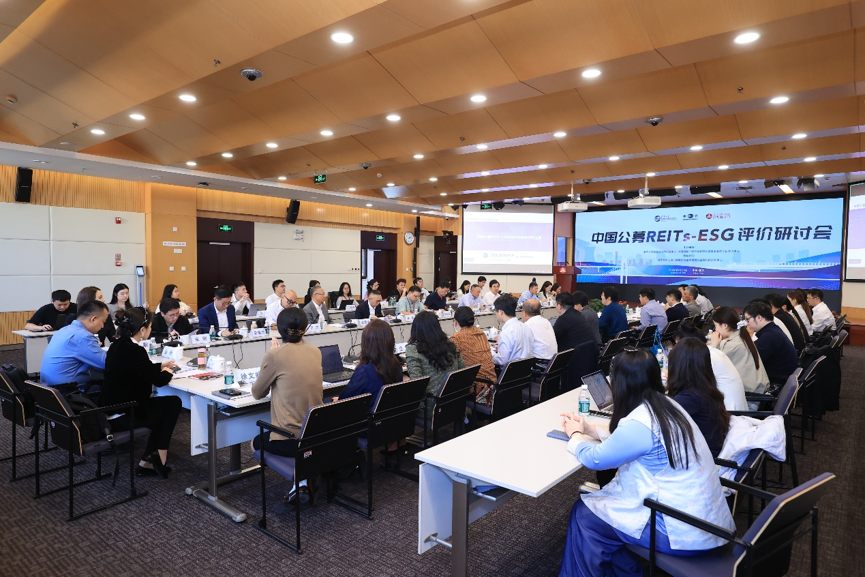
Photo: Venue of the seminar on ESG evaluation for China’s publicly offered REITs
The seminar focused on building an ESG evaluation system for China’s publicly offered REITs that integrates international standards, China’s national conditions, and industry characteristics. Participants engaged in comprehensive discussions spanning the evaluation framework, indicator system, data acquisition, evaluation methodologies, application of results, and implementation pathways.
Attendees widely agreed that launching ESG evaluation for publicly offered REITs is timely. It represents a constructive initiative to benchmark against high-standard international rules while enriching and extending global ESG evaluation practices—which have predominantly focused on listed companies. The initiative is significant not only for elevating China’s voice in international ESG rating practices, but also for stimulating private investment vitality, advancing high-quality economic development, and contributing to Chinese modernization.
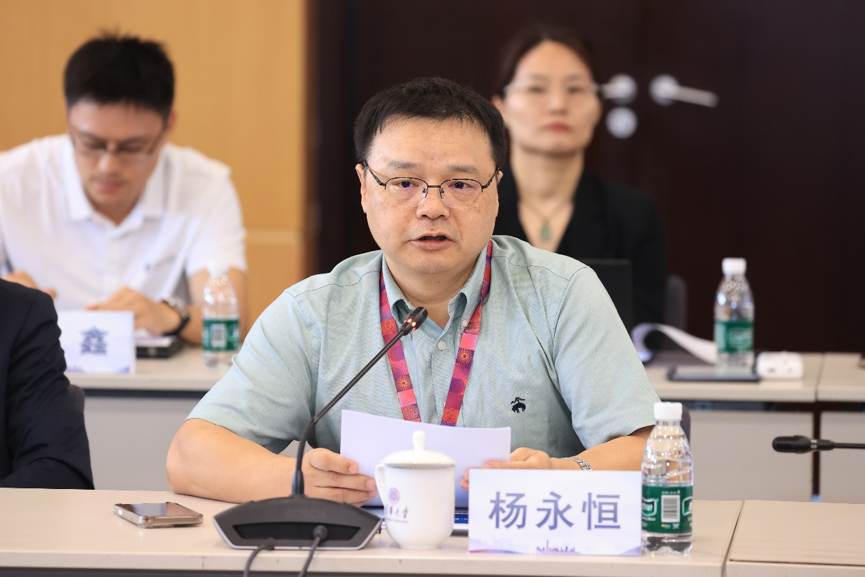
Photo: Yang Yongheng chairs the seminar and introduces the research background
Yang Yongheng pointed out that while ESG evaluation has evolved into a relatively mature system internationally, it currently targets corporations, especially listed companies. In 2022, relevant national policies explicitly proposed exploring environmental, social, and governance evaluation at the investment project level, driving the extension of ESG evaluation from corporate entities to asset projects. Given that China’s fixed-asset investments are ultimately realized through specific projects, conducting ESG evaluation at the project level is an essential endeavor to identify high-quality investment projects and promote effective investment.
Yang noted that publicly offered REITs bridge specific infrastructure assets on one end and the public capital market on the other. Characterized by well-defined asset boundaries, continuous operational disclosure, and observable market pricing, REITs are uniquely positioned to link a project’s ESG performance with its long-term operations and asset valuation. This provides an ideal entry point and application scenario for project-level ESG evaluation. He added that the joint research endeavor by Tsinghua’s Research Center for Investment and Financing Policy, PBCSF, and CIECC’s Capital Business Innovation Consulting Center is also a concrete measure to implement the strategic cooperation agreement between Tsinghua University and CIECC.
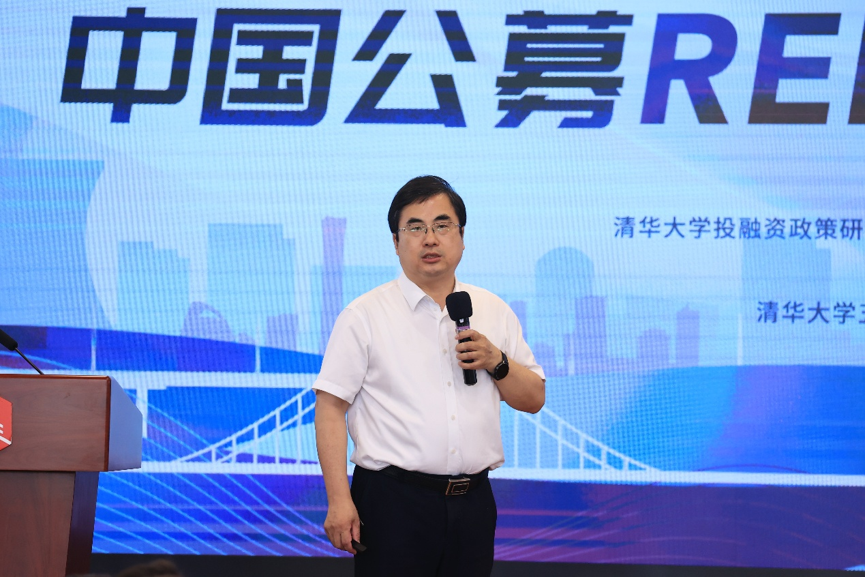
Photo: Xu Chengbin presents the research findings and latest progress
Xu Chengbin delivered a systematic presentation on the research findings and latest progress. He observed that while some publicly offered REITs have voluntarily released ESG reports, disclosures still vary widely in content scope, indicator definitions, and reporting standardization. In early 2026, CIECC’s Capital Business Innovation Consulting Center joined forces with Tsinghua’s Research Center for Investment and Financing Policy and PBCSF to form a research team, which has established an industry-wide ESG evaluation framework tailored to the project level and REIT characteristics.
Guided by the orientation of being "China-specific, project-based, and REIT-tailored," the research underscores that data must be "available, quantifiable, and comparable." Frameworks have been developed across ten industries, forming a four-tier architecture: "Evaluation Dimensions – General Indicators – Core Indicators – Industry-Specific Indicators," comprising the three E, S, and G dimensions, nine general indicators, a pool of core indicators, and industry-representative metrics. Furthermore, the team has built an LLM-powered evaluation data platform. Validation shows that existing publicly disclosed REIT disclosures are already sufficient to support the calculation and analysis of the majority of these evaluation metrics.
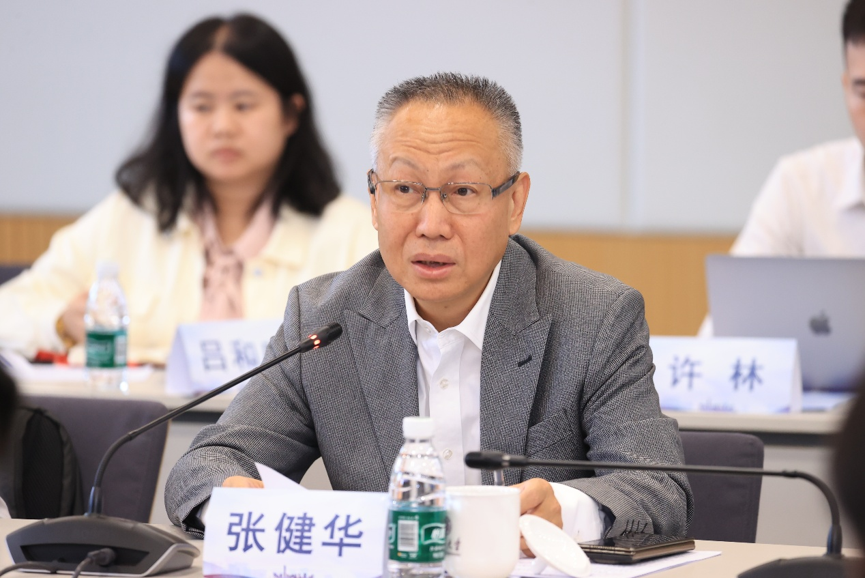
Photo: Zhang Jianhua shares perspectives on long-term market development
Zhang Jianhua shared insights from the perspective of long-term market development. He pointed out that the next phase of China’s publicly offered REITs market is shifting from merely scaling up new issuances to enhancing sustained operational capabilities. After resolving the initial hurdle of "getting products issued," the market must address the deeper question of "ensuring long-term viability." Against this backdrop, the primary value of ESG evaluation lies in establishing a disclosure and assessment system that "clearly presents and accurately evaluates" asset quality, operational resilience, governance stability, and long-term risks—areas of core concern to long-term capital. He specifically emphasized that delineating the boundary of responsibility for operating and management entities, as well as establishing effective incentive, constraint, and accountability mechanisms, is a pivotal question that the evaluation system, particularly the governance (G) dimension, must address.
The meeting concluded that since the debut of China’s first batch of publicly offered REITs in June 2021, the market has maintained stable operations and steadily transitioned into a phase of normalized issuance. The present is a crucial juncture to review existing practices, synthesize market experience through ESG evaluation, and provide guidance for the next phase of high-quality growth. Market development must look beyond whether an asset can be successfully issued; greater emphasis must be placed on post-issuance operational performance—moving from merely "getting issued" to "standing firm and viable." Implementing ESG evaluation for publicly offered REITs will help mobilize the enthusiasm of all market participants and foster a win-win, long-term mechanism: For sponsors/originators, superior ESG performance enhances long-term asset value and facilitates future follow-on offerings and the revitalization of existing assets; For fund managers, underlying project operational performance directly impacts their market credibility; For operating and management entities, favorable ESG ratings serve as both recognition of professional operational capability and an incentive for continuous improvement; For investors, the evaluation provides vital non-financial information to assess long-term asset risk, operational quality, and fundamental value. The seminar emphasized that the evaluation system must absorb mature international practices while remaining firmly anchored in the operational dynamics of Chinese assets and the realities of China’s REITs market, adhering to the fundamental direction of being "China-specific, project-based, and REIT-tailored." Going forward, implementation should proceed progressively with iterative refinements to establish a scientific, feasible, and sustainable evaluation mechanism that underpins the high-quality development of China’s publicly offered REITs market.