Recently, Dr. Min Zhu, Former Deputy Managing Director of the International Monetary Fund (IMF) and Former Deputy Governor of the People’s Bank of China, engaged in an in-depth dialogue with Dr. Yaqin Zhang, Academician of the Chinese Academy of Engineering, Chair Professor at Tsinghua University, and President of the Institute for AI Industry Research (AIR) at Tsinghua University. The two scholars explored key issues surrounding the evolution of Artificial General Intelligence (AGI) and the dynamics of innovation competition between China and the United States. Professor Jie Jiao, Dean of Tsinghua University PBC School of Finance (Tsinghua PBCSF), delivered the opening remarks. More than one hundred guests, including faculty, students, and alumni of Tsinghua PBCSF, attended the event.

Photo: Dean Jie Jiao delivering the opening remarks.
At the beginning of the discussion, Zhu and Zhang used Zhang’s new book Emerging Intelligence as a starting point to delve into the core logic of the new wave of artificial intelligence development. Dr. Zhang highlighted three key concepts driving AI breakthroughs today — Tokenization, Scaling Law, and Emerging. Beyond technological progress, he noted that the current AI revolution demonstrates an “industrial emergence,” where the “AI+” model is deeply permeating various industries. Dr. Zhu summarized that this shift marks a transformation from “curve-based growth” to “surface-based diffusion,” symbolizing AI’s comprehensive integration across multiple sectors of the economy.
Dr. Zhang projected that the next stages of AGI development could unfold as follows: information intelligence within about 4 years, physical intelligence within 10 years, and biological intelligence within 15 to 20 years. When asked by Dr. Zhu about “human-machine collaboration,” Zhang outlined a vision of “AI + HI (Human Intelligence)”, emphasizing that human self-awareness and the value-oriented principle of “guiding AI for good” are crucial. Both experts agreed that the evolutionary paths of humans and AI differ significantly in speed and nature, and that finding a sustainable way for the two to adapt to each other is one of the most urgent questions of our time.
On the topic of AI safety and controllability, Dr. Zhang expressed a rational yet optimistic outlook. He pointed out that AI algorithms and rules are ultimately defined by humans, and that historical experience from past industrial revolutions shows that while technological change brings short-term challenges, its long-term positive impact always prevails. Dr. Zhu underscored the importance of ensuring AI serves the public good, noting that humanity’s ability to learn, to adapt alongside technology, and to maintain moral integrity will be the foundation for addressing AI-related risks in the future.
Discussing China–U.S. competition in AI, Dr. Zhang observed that since the emergence of models such as DeepSeek, the two countries have entered a stage of “mutual wins in different arenas.” He noted that China has developed distinctive technical paths and business models in low-compute and open-source large model scenarios, while still lagging in computing infrastructure and ecosystem development. However, Chinese chip companies are rapidly catching up through diverse technological routes. Dr. Zhu added that China now leads globally in “AI+” industrial applications and vertical domain models. He emphasized that supportive policies such as the “Twenty Measures on Data” and the promotion of public data sharing have further accelerated China’s AI ecosystem. Dr. Zhang further analyzed that as the scaling law of pre-training slows down, the focus of research is shifting toward post-training optimization, inference efficiency, and AI agents, which presents new hardware challenges and opens new opportunities for innovation and application in China.
Dr. Zhu highlighted that future competition will increasingly center on open-source versus closed-source ecosystems and corresponding business models. Dr. Zhang, drawing parallels to the mobile internet era, predicted that both open-source and closed-source models will coexist for a long time. While open source accelerates collective innovation and real-world deployment, it operates at multiple layers in the large-model era, differing from earlier digital ecosystems. He also contrasted business models between the U.S. and China, noting that some U.S. companies have monetized through token mechanisms, whereas China is more likely to focus on the commercialization of the “AI+” model in diverse industries.
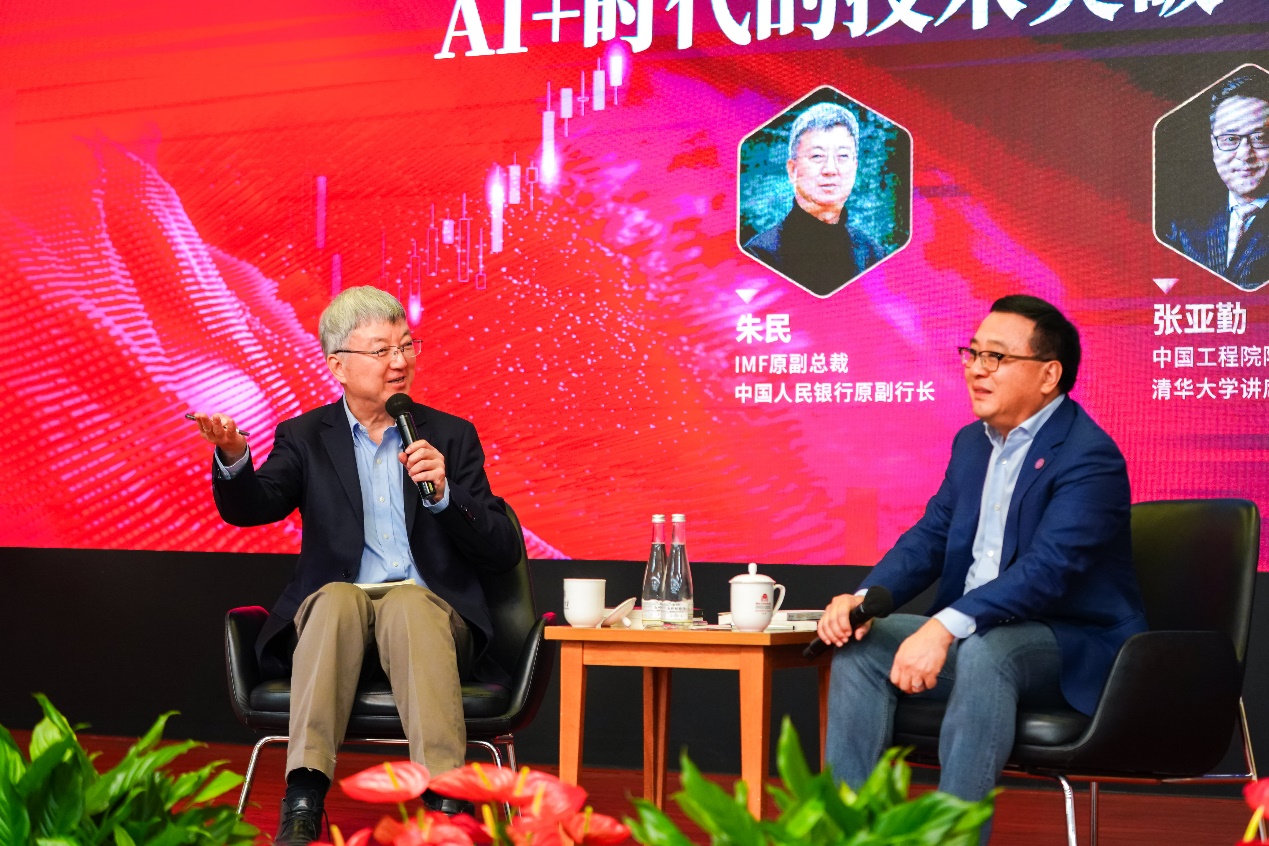
Photo: Dr. Min Zhu in conversation with Dr. Yaqin Zhang.
During the Q&A session, students and alumni raised insightful questions on topics such as the limitations of the Turing test in the multimodal era, interoperability standards among intelligent agents in the Internet of Things (IoT), and paradigm shifts in AI theoretical foundations. When asked whether AI can possess fast and accurate intuition, Dr. Zhang cited Daniel Kahneman’s Thinking, Fast and Slow, explaining that while human cognition involves both “System 1” (fast thinking) and “System 2” (slow thinking), current AI remains largely within the latter stage — powerful in computation and efficiency, yet lacking true intuition, emotion, and consciousness. Dr. Zhu emphasized that innovation cannot arise in a vacuum: learning remains the foundation. He encouraged individuals to use large models as tools for building personal thinking frameworks, concluding: “Humans must evolve from being carriers of knowledge to becoming carriers of thought and wisdom.” He noted that the AI era is transforming the world profoundly and raising the bar for human capability — but that faith in human nature, goodness, and learning ability remains our greatest strength.
This event was co-hosted by Tsinghua PBCSF and the Institute for AIR, and organized by the Global Economic Governance 50 Forum (GEG50).

Photo: The dialogue session at Tsinghua PBCSF.