On November 3, the closed-door seminar on “Analysis of World Economic and Financial Development in 2026” was successfully held in Beijing. The event brought together senior officials and economists from the International Monetary Fund (IMF). Leading Chinese scholars also participated, including Gao Peiyong, Academician of the Chinese Academy of Social Sciences (CASS); Huang Hanquan, Director of the China Academy of Macroeconomic Research; Lu Feng, Professor at the National School of Development, Peking University; and Zhang Xiaojing, Director of the National Institution for Finance & Development, CASS. Commentators included Miao Yanliang, Managing Director at CICC, and Professor Shi Kang of the Chinese University of Hong Kong and the PBC School of Finance at Tsinghua University. The seminar was chaired by Zhu Min, Senior Expert Advisory Committee Member of CCIEE and Former Deputy Managing Director of the IMF.
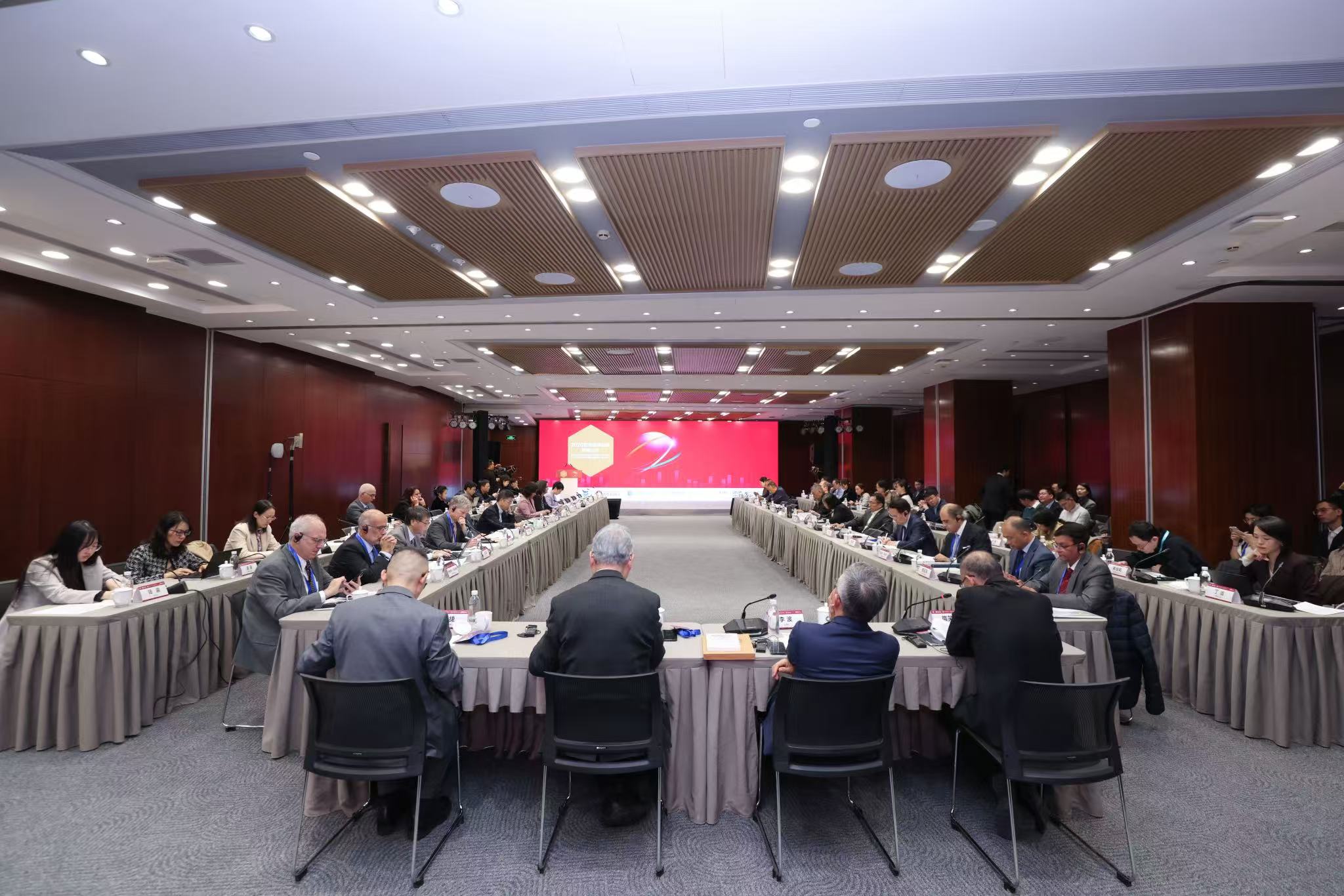
Photo: Seminar venue
In the opening remarks, Jiao Jie, Dean of the PBC School of Finance at Tsinghua University, introduced the School’s recent development and highlighted the core themes of the seminar, expressing its strong commitment to deepening collaboration with the IMF. Sui Xiaofei, Vice President of the Academy of Contemporary China and World Studies (ACCWS), emphasized that the certainty, high-quality growth, and inclusive features of China’s economic development continue to make important contributions to global prosperity.
During the presentations by IMF economists, participants discussed key findings from the Global Financial Stability Report, the Regional Economic Outlook: Middle East and Central Asia, and the Regional Economic Outlook: Asia and Pacific. In the session on world macroeconomic developments, Miao Yanliang examined the impact of the AI revolution on the global economy and financial markets, while Professor Shi Kang addressed structural divergences in inflation across major economies and the evolving dynamics of international competition in AI. Participants engaged in further discussion on topics such as the link between AI and asset bubbles, the role of industrial policy, developments in cryptocurrencies, and the broader evolution of the international monetary system.
In the session on Asia and China’s macroeconomic outlook, Gao Peiyong analyzed China’s fiscal landscape through the framework of its four-tier budgetary system. He presented the fundamental mechanisms shaping China’s fiscal operations, offered projections for the 2026 fiscal outlook, and identified three major structural changes in fiscal expenditure patterns. He further drew on the discussions of the Fourth Plenary Session of the 20th CPC Central Committee to outline future trends and provided a detailed interpretation of shifts in tax revenue composition and local public finance.
Building on the latest economic indicators, Huang Hanquan examined China’s current macroeconomic conditions and key driving forces, offering his projections for China’s growth potential during the upcoming Fifteenth Five-Year Plan. He also delivered a focused discussion on the theme of “advancing new quality productive forces in line with local conditions.”
Lu Feng presented his analysis of China’s balance of payments outlook, noting that China’s trade surplus as a share of global total has reached a historic high, reflecting significant internal and external imbalances. He argued that the underlying causes include external shocks, relatively weak domestic demand despite strong supply capacity, and the depreciation of China’s real effective exchange rate. He emphasized that persistent household consumption weakness warrants particular attention and suggested that China adopt a new economic rebalancing strategy to address these structural challenges.
Focusing on financial conditions, Zhang Xiaojing analyzed China’s macro leverage ratio and noted that the leverage growth of the government sector has accelerated, while that of other sectors has moderated. He argued that, given current debt and interest burdens, lower interest rates and structural adjustments in the financial system play an important role in supporting countercyclical policy. He stressed the need for China to strengthen balance-sheet management, redirect more public financial resources toward households, and increase investment in human capital and essential public services.
During the discussion session, participants held in-depth exchanges on a wide range of topics, including the relationship between pension system design and household consumption, methodologies for measuring leverage ratios, the interaction between balance-sheet expansion and productivity gains, and the evolving progress of regional trade integration in the Asia-Pacific.
The seminar was jointly hosted by the International Monetary Fund, the PBC School of Finance of Tsinghua University (PBCSF), the Academy of Contemporary China and World Studies (ACCWS), and the Center for Education, Innovation and Sustainable Development at Shanghai Tech University, and organized by the Global Economic Governance 50 Forum (GEG50) and the Research Center for China Financial Frontier at PBCSF.