On March 12, the appointment ceremony for a Distinguished Visiting Professor of Tsinghua University was held at PBC School of Finance, Tsinghua University (Tsinghua PBCSF). Xuewen Liu, Professor of Finance at HKU Business School, the University of Hong Kong, was officially appointed as Distinguished Visiting Professor. Xiaoyan Zhang, Associate Dean and Chair Professor of Finance at Tsinghua PBCSF, hosted the ceremony and presented the appointment letter to Professor Liu.
Professor Liu’s appointment marks a new milestone in Tsinghua University’s efforts to attract world-class academic talent and expand high-level academic cooperation. It will also provide strong support for Tsinghua PBCSF to further advance the development of financial disciplines rooted in China’s context, enhance its international academic influence, and contribute to China’s goal of becoming a leading financial power.
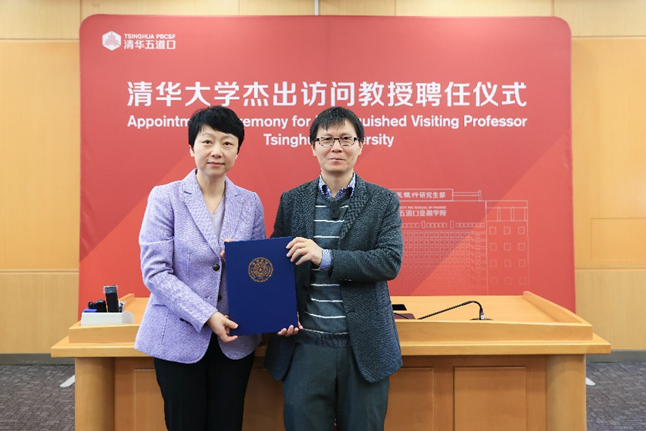
Photo: Professor Xuewen Liu is appointed Distinguished Visiting Professor of Tsinghua University and receives the appointment letter from Professor Xiaoyan Zhang
As a world-renowned scholar in finance and economics, Professor Xuewen Liu’s research spans financial economics, macroeconomics and development economics. His research examines the mechanisms governing financial and economic activity in complex real-world settings, with wide-ranging contributions to the study of systemic financial risk, macroeconomic fluctuations, and national development. His work has been published in top-tier international journals such as The Journal of Finance, Journal of Financial Economics, The Review of Financial Studies, Journal of Economic Theory and Journal of Monetary Economics.
As a distinguished theoretical economist, Professor Liu’s core contribution to financial theory centers on identifying a “self-fulfilling” mechanism in the financial system. His pioneering research on systemic bank runs develops a theoretical framework that captures the interaction between the interbank market and creditor runs, clarifying how small shocks can be amplified into systemic financial crises. His research on the interaction between financial markets and the real economy explains the concurrent rise in financial and real economic uncertainty during economic recessions. Regarding the correlation between credit expansion and financial crises, the “excessive delay” theory he proposed reveals that even when banks recognize the deteriorating fundamentals, they may rationally postpone exiting high-risk sectors, leading to deeper crises and slower recoveries. He also introduced a dual-run framework involving short-selling and creditor runs, uncovering how the interplay between speculators and depositors can exacerbate uncertainty about banks’ fundamental values. These theoretical achievements provide a robust analytical framework for understanding financial stability issues in China and other emerging economies.
Beyond his in-depth research in financial theory, Professor Liu also offers deep insights into industrial policy and economic development. Prior to the appointment ceremony, he delivered an insightful academic lecture to attending faculty and students entitled “When to Act? Market Forces, Government Intervention and the Optimal Timing of Industrial Policy”. Focusing on the core proposition of industrial policy effectiveness, the research, which combines a theoretical model with empirical analysis of China’s industrialization process, leads to the conclusion that the key to a successful industrial policy depends less on the intensity of intervention than on the precise timing of that intervention. The research suggests that market forces gradually enhance the competitiveness of new technologies amid changes in factor prices, technological progress and demand shifts. However, due to the critical scale effect in technological diffusion, the private sector may remain trapped in a low-level equilibrium as it is unable to internalize externalities. Premature government intervention will cause welfare losses by distorting the market, while delayed intervention may forgo the benefits of positive externalities. An effective industrial policy does not replace the market; instead, it intervenes in alignment with market trends at the critical juncture when market forces reach a tipping point, thereby amplifying the market’s development momentum. Grounded in rigorous theoretical and empirical analysis, the lecture provided a compelling illustration of how to forge a synergy between a “proactive government” and an “efficient market”, inspiring all faculty and students in attendance.
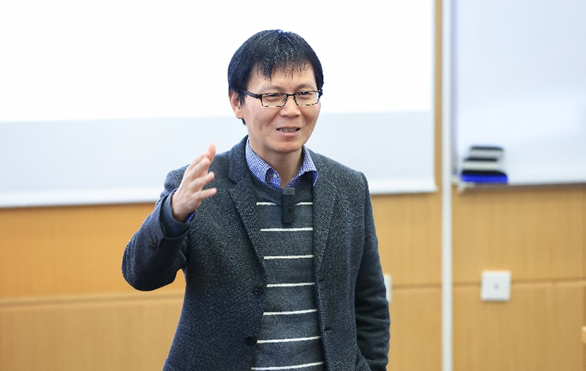
Photo: Professor Xuewen Liu delivers an academic lecture.
The Distinguished Visiting Professor is an honorary academic title awarded by Tsinghua University to distinguished overseas scholars and senior executives of world-renowned multinational enterprises. All appointees are leading figures who have achieved outstanding accomplishments in their respective fields and possess outstanding international academic or industrial influence. They are expected to engage in substantive cooperation with the university across talent cultivation, collaborative scientific research, discipline development and the expansion of international partnerships. This title is not only a high recognition of the appointees’ professional achievements, but also a strategic initiative for Tsinghua University to promote international academic exchanges, deepen high-level talent cooperation and advance the construction of a world-class university.
For the next five years, Tsinghua PBCSF will make it a central priority to serve the national strategy of building a powerful financial country and promoting the high-quality development of the financial sector. It will accelerate the development of an independent financial knowledge system with Chinese characteristics, further advance the theoretical research on the path of financial development with Chinese characteristics, strive to build a top-tier financial think tank with practical collaboration capabilities, and continuously enhance the global influence and discourse power of China’s financial academia. Professor Liu’s appointment brings new academic perspectives and research impetus to the School’s in-depth study of the experience of financial development with Chinese characteristics and its interpretation of the internal logic and unique path of China’s financial development. In the future, relying on the School’s unique advantages of integrating industry, academia and research, both parties will focus on the vivid practices of China’s financial reform and macroeconomic development, conduct in-depth cooperation in academic research, discipline development and talent cultivation, cultivate top financial talents with a global perspective and a strong understanding of China, and contribute the financial strength of Tsinghua PBCSF to the comprehensive advancement of Chinese modernization.